Read your AI Visibility score
What does my AI Visibility score actually measure?
AI Visibility is a rank score. Synup asks ChatGPT, Gemini and Perplexity a set of discovery questions about your category and city, then scores each answer on whether you were named and how near the top. Nothing else feeds it — not your rating, not your review count, not your directory listings.
That is the single most useful thing to know about this page, because the Visibility factors panel sitting right underneath the score is measuring completely different things.
What the Overview is showing you
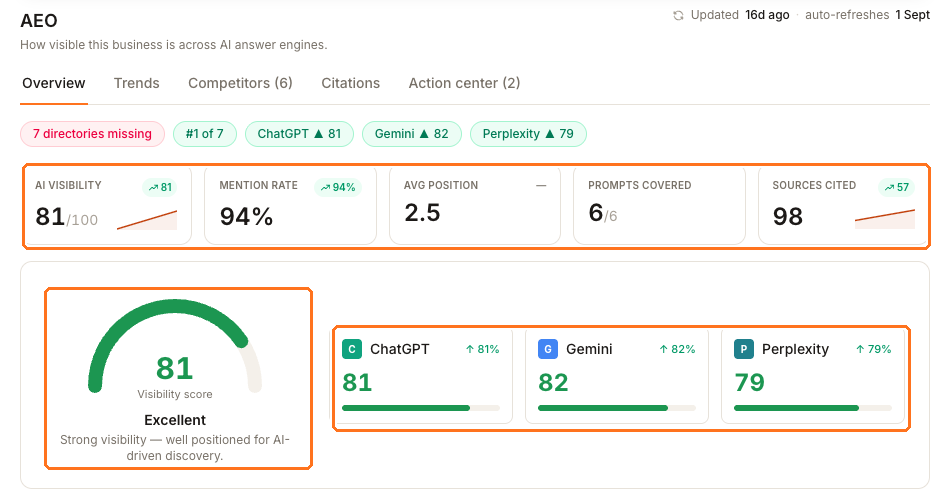
Three boxes, and they are the whole page in miniature: the metrics row, the score with its label, and how that score breaks down by engine. The prompt grid explains the rank score; the factor and citation sections show separate signals you can investigate alongside it.
Why an 81 can sit next to a Reviews score of 0
Here is that same agency's Visibility factors panel, sitting a few centimetres below its Excellent gauge.
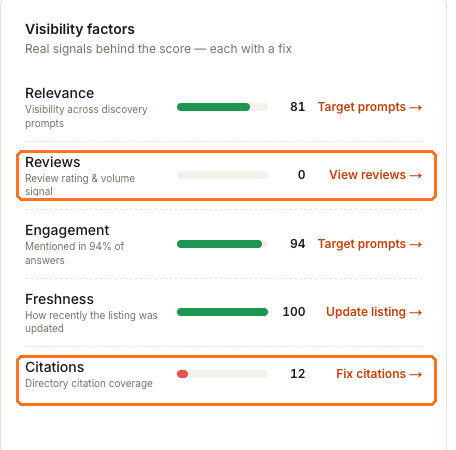
Only one of those five is inside the score.
| Factor, and what it measures | Feeds your AI Visibility score? |
|---|---|
| Relevance — how visible you are across the discovery questions | Yes — this is essentially the score itself |
| Reviews — your rating and review-volume signal | No |
| Engagement — the share of answers that mention you | No |
| Freshness — how recently the listing was updated | No |
| Citations — directory citation coverage | No |
A score of 81 alongside Reviews 0 and Citations 12 is not a bug and not a contradiction. The rank score records what happened in the tracked AI answers; the Reviews and Citations factors report separate signals.
Read the factors as places to investigate, not as inputs to today's number or proof of why an engine ranked you. A low factor can help you choose what evidence to inspect next, but this report does not establish that changing it caused — or will cause — a visibility change.
The five numbers across the top
The KPI row is the fastest read on the page, and each number answers a different question.
| Metric | On this location | What it tells you |
|---|---|---|
| AI Visibility | 81/100 | How often and how highly you're named |
| Mention rate | 94% | The share of answers you appear in at all |
| Avg position | 2.5 | Where you land when you appear — lower is better |
| Prompts covered | 6/6 | Distinct questions where at least one engine named you |
| Sources cited | 98 | The current citation-coverage total: recognized cited directories, other detected domains and missing key directories |
Mention rate and Avg position are the pair worth watching together. A high mention rate with a poor average position means you appear often but usually lower in the answer. This location is named in 94% of its engine-and-prompt answers at an average position of 2.5, so its clearest remaining gap is the one engine-and-prompt cell where it is absent, not broad visibility across all six questions.
Sources cited is not a count of sources citing you. In the current Product calculation, it is a coverage total: recognized directories found in the answers, other detected domains, and key directories still missing. That is why it can remain nonzero even when your visibility is zero.
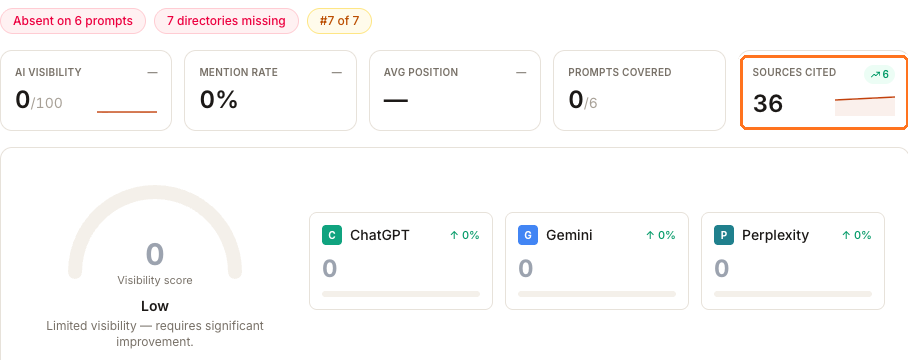
This Fairbanks bed & breakfast scores 0/100 — Low, is named in no answer on any engine, and still reports a 36-point source-coverage total. That does not mean 36 sources cited the business. It shows that source coverage and business visibility answer different questions. Its chips say the rest: Absent on 6 prompts, #7 of 7.
The bands, and what they're called
| Score | Label the product shows |
|---|---|
| 81–100 | Excellent — "Strong visibility — well positioned for AI-driven discovery." |
| 61–80 | Good — "Good visibility with room for improvement." |
| 41–60 | Average |
| 21–40 | Below average |
| 0–20 | Low — "Limited visibility — requires significant improvement." |
The boundaries are tighter than they look. A Texas auto-repair shop scoring 79 reads Good; the Miami agency at 81 reads Excellent. Two points, different words. Don't let the label do more work than the number.
Sydekick's read, and when to trust it
Above the page title you'll see a Sydekick's read bar, or Write one if no read exists yet. It generates a one-sentence summary of what it sees.
Treat it as a prompt to look, not as a finding. On the same 81-scoring location above, it produced "…misses key Miami prompts while competitors dominate search results." That sentence is anchored on one genuinely absent prompt, but it describes a location that is named in 94% of answers at position 2.5 as though it were losing. The numbers on the page are the authority.
Where to go next
- How do I read the prompt coverage grid? — the grid behind the score, one prompt and one engine at a time
- Where does this report come from? — when reports are generated, what a run costs and when the numbers refresh