
Read citations coverage
Which sources do AI engines cite when they answer about me?
When an assistant answers a question about your category, it reads sources first. Citations shows which ones — split into recognised directory sources, everything else the engines pulled in, and the well-known directories that never appeared. The third tile is the one with a direct Fix in Listings hand-off.
The three tiles
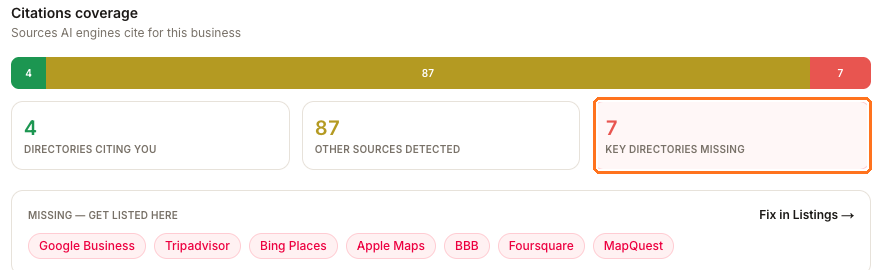
On a Miami real-estate agency the split reads 4 · 87 · 7:
Directories citing you
- Count here
- 4
- What it is
- recognised directory domains that appeared in the cited-source set
- What to do
- confirm your information on these directories is complete and accurate
Other sources detected
- Count here
- 87
- What it is
- everything else the engines cited — blogs, local press, agent roundups, rival firms' own sites
- What to do
- read them for what earns a mention in your category
Key directories missing
- Count here
- 7
- What it is
- well-known directories that never appeared as a source at all
- What to do
- get listed, starting with the ones your customers actually use
Those three add up to the displayed Sources cited KPI — 98 here. In the current Product, that is a coverage total, not a literal count of cited sources: 4 directory sources + 87 other detected sources + 7 missing directory slots. If you need the number of distinct sources that actually appeared in these tiles, add the first two instead — 91 here.
The missing list is the actionable part
Under Missing — get listed here the product names the directories outright rather than making you infer them. On this location: Google Business, Tripadvisor, Bing Places, Apple Maps, BBB, Foursquare and MapQuest, with a Fix in Listings → button that takes you to the tool that fixes it.
Google Business appearing in that list on a location scoring 81 is worth pausing on. It does not mean the profile is broken. It means that across these particular answers, no engine cited Google as a source — they cited property blogs and agent directories instead. Different categories get read differently, and a directory that matters enormously for a restaurant may never surface for a real-estate firm.
Read the per-engine columns for where to publish
Below the tiles, each engine lists the sources it actually cited. They overlap far less than you would expect:

| Engine | Sources it leaned on for this location |
|---|---|
| ChatGPT | Almost entirely individual agency and agent websites — bluepropertiesre.com, kamanyrealty.com, mikeplaton.com |
| Gemini | Review and comparison sites — goodfirms.co, ratemyagent.com, expertise.com, birdeye.com |
| Perplexity | Large portals and trade press — realtor.com, zillow.com, therealdeal.com |
That pattern gives this location three places to investigate: its own site, comparison sites, and the large portals. It is evidence from this report, not a universal rule about the engines; compare the columns again after the next report before turning the pattern into a broader content strategy.
A high coverage total is not visibility
A location can have a high Sources cited display and still have low or zero AI visibility. The engines can cite many sources while answering category questions without naming the business, and the displayed total also includes the missing-directory slots described above.
Use the visibility score and prompt coverage to learn whether the business appeared. Use Citations to learn which sources shaped the answers and which recognised directory sources were absent. One number cannot stand in for the other.
Questions people ask
Getting listed didn't change my citations. Why?
Reports are monthly snapshots, and being listed is not the same as being cited — the engine has to choose your listing as a source when it answers. On the next report, first check whether the directory left the missing list; it will appear in the engine columns only if an engine actually cited it.
Why is a competitor's own website in my citations?
Because the engine cited it while answering your question. Rival sites appearing as sources is normal and is a useful signal: it tells you what the assistant considered authoritative enough to quote.
Where to go next
- What should I fix first? — where the missing-directories count becomes a ranked action
- How do I update a location's listings? — the tool the Fix in Listings button opens