
Compare AI competitors
Who do AI assistants recommend instead of me?
You did not choose these competitors. The Competitors tab lists every business the answer engines actually named while answering your discovery questions, scores each one the same way you are scored, and ranks the lot. It is a measure of who is winning the conversation, not of who you consider a rival.
Reading the leaderboard
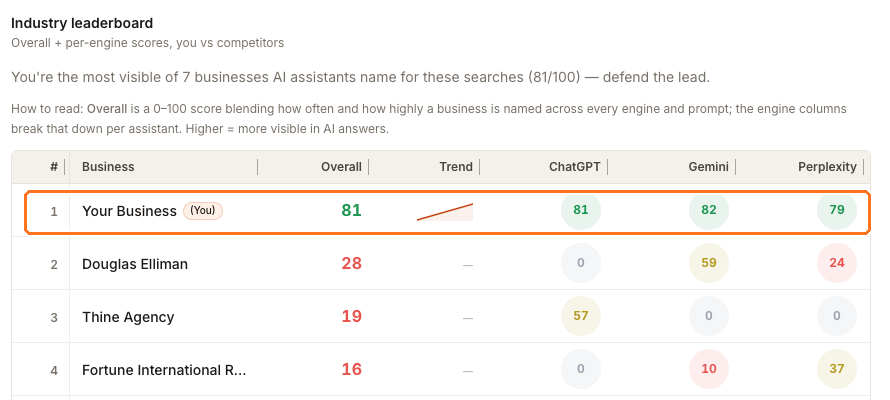
The summary line above the table states your standing plainly — "You're the most visible of 7 businesses AI assistants name for these searches (81/100) — defend the lead." Below it, you are always the row marked (You).
Your Business (You)
- Overall
- 81
- ChatGPT
- 81
- Gemini
- 82
- Perplexity
- 79
Douglas Elliman
- Overall
- 28
- ChatGPT
- 0
- Gemini
- 59
- Perplexity
- 24
Thine Agency
- Overall
- 19
- ChatGPT
- 57
- Gemini
- 0
- Perplexity
- 0
Fortune International Realty
- Overall
- 16
- ChatGPT
- 0
- Gemini
- 10
- Perplexity
- 37
Two things in that ranking are easy to miss.
Your own row is labelled "Your Business", not your business name. Competitors are named; you are not. It is the (You) badge that identifies the row, so read that first if you are scanning quickly.
The Overall number hides more than it shows. Douglas Elliman and Thine Agency score 28 and 19 — but Douglas Elliman is invisible on ChatGPT and respectable on Gemini, while Thine Agency is the exact reverse. Neither is a general threat. Each is a threat on exactly one engine, and only the per-engine numbers say so.
Competitors are scored exactly like you
A competitor that fails to appear for a question scores 0 for that question, just as you would. The averages are taken over the same set of questions, so the comparison is fair in both directions — and a rival who dominates two questions and misses four will sit lower than their reputation suggests.
That symmetry is what makes a low competitor score readable. A 19 does not mean the business is small; it means the assistants rarely name it for these questions.
Ranking gap: how high, not how often
Under the leaderboard, Ranking gap answers a different question. It takes only the answers where a business was named at all and splits them into three bands — ranked 1–3, ranked 4–10, ranked 11 or lower — as a bar per business.
A larger green share means the business ranked higher when it was named. Every bar is normalized to the appearances for that business, so its width does not show how often the business appeared. Read the leaderboard for overall visibility across all questions; read Ranking gap for placement among the answers where each business appeared.
When a location has never appeared in any answer, this section says so rather than drawing an empty chart, and the summary reads "This business doesn't rank in any AI answers yet — the goal is to start appearing, then climb into the top 3."
What to do with a competitor you didn't know about
The names here come out of real answers, which makes them worth investigating. When an unfamiliar business is beating you on a question that matters, open that question's cell on the Overview tab and inspect the captured answer, position and cited sources. That evidence tells you what the assistant actually returned; it does not prove why the assistant chose that competitor.
Where to go next
- How do I read the prompt coverage grid? — find the exact questions you're losing
- What should I fix first? — the ranked list Synup builds from this data