
Best local SEO affiliate programs compared: what one referral really pays
The best local SEO affiliate program for you depends on what one referral actually pays over time, not the headline rate. Harsha Dindi, who runs Synup's affiliate program, compares seven programs (Synup, GoHighLevel, Semrush, Moz, BrightLocal, Whitespark and Birdeye) with one illustrative customer paying $100 a month for two years, shows when a one-time payout wins, and walks through the fine print that changes what you earn: what the percentage is paid on, whether a higher tier applies to earlier referrals, cookie windows, reversals, promotion rules and paid reviews.
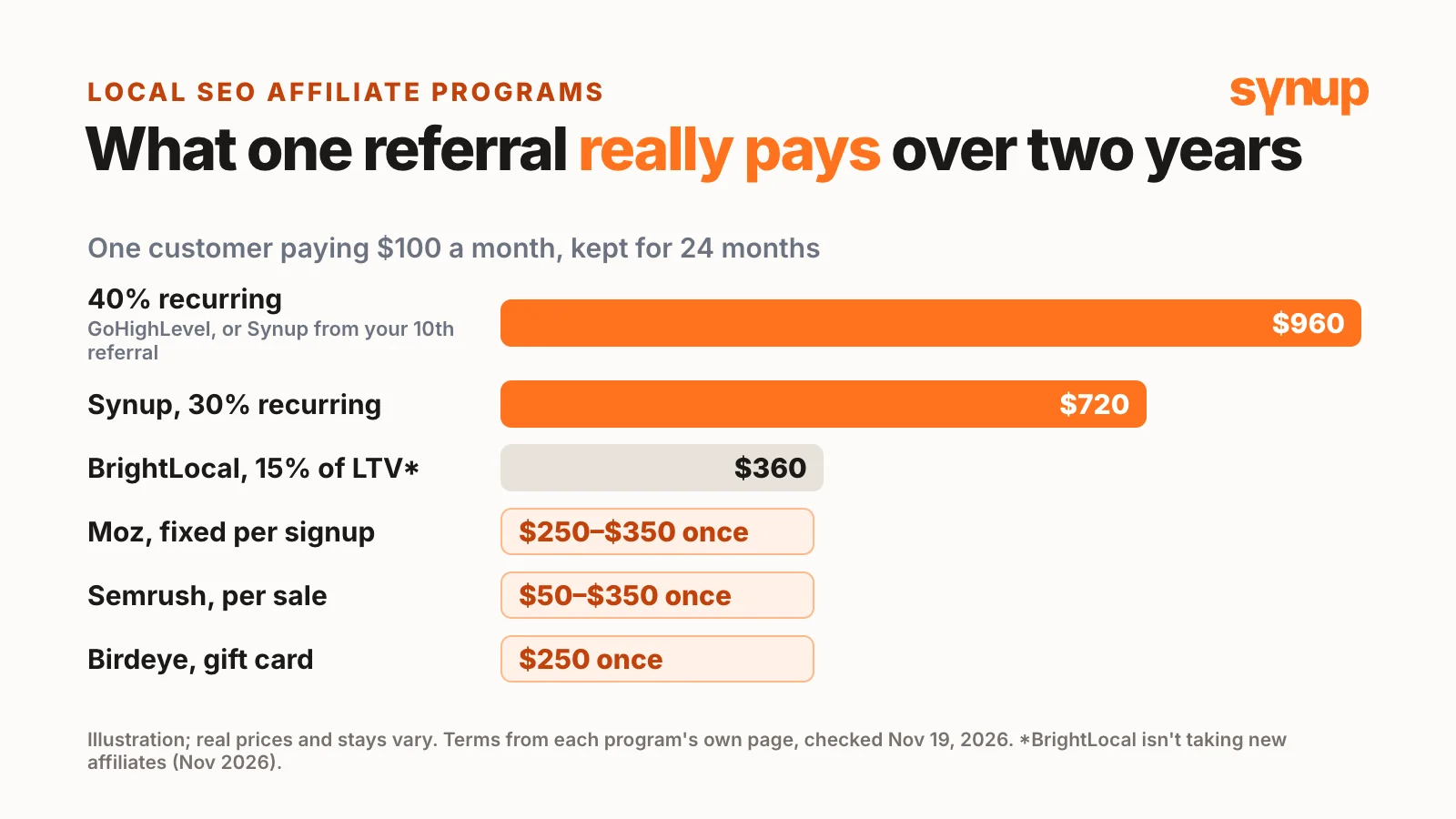
Say you refer one business to a local SEO tool, and that business pays $100 a month and stays for two years. Depending on the affiliate program you picked, that one customer could pay you $960, or a one-time amount as small as $50. It’s the same customer over the same two years, with a very different amount of money in your pocket.
Harsha Dindi looks after affiliate partnerships at Synup, so Harsha runs one of the programs compared here and says so up front, including where the others pay more. Every program’s terms below come from its own page, checked on November 19, 2026, so you can check them yourself.
Short answer: The best local SEO affiliate program is the one your audience will actually use, measured by what one referral pays over time, not by the headline rate. Pick one realistic customer and how long they’d stay, run every program’s terms through the same test, then read the fine print: what the percentage is paid on, whether a higher tier is backdated, the cookie window, reversals and promotion rules. For an audience of local businesses and the agencies and consultants who serve them, Harsha’s pick is Synup’s program; for agencies building everything on one all-in-one platform, GoHighLevel.
Watch: the best local SEO affiliate programs compared
Why local SEO software is worth promoting
Think about the last time you looked for a dentist, a plumber or a place to eat nearby. You searched, saw the map, checked the ratings, maybe checked whether they’re open on Saturday, and decided, often without opening a website. Many Google searches now show an AI answer above the map, and people also ask ChatGPT and other AI tools where to go. Those answers draw on a business’s listings and reviews.
So for any business with a physical location, keeping listings and reviews accurate isn’t a one-time fix. It’s a recurring job that takes continuous effort, and most owners are too busy running the business to keep up with it. That’s good news for an affiliate:
- It’s billed monthly.
- Once a business sets it up, it usually stays, because the work never ends: new reviews keep coming in and details keep changing.
- Your audience already has the problem. Agency owners, consultants, franchise owners and local business owners don’t need convincing that they need something new; you’re showing them a better way to handle something they already deal with.
When the product is something people pay for every month, a recurring commission pays you every month too.
The 7 local SEO affiliate programs compared
Terms from each program’s own page, checked November 19, 2026. Programs change their terms, so confirm on the page before you plan around a number.
| Program | How it pays | Rate or amount | Cookie | Worth knowing |
|---|---|---|---|---|
| Synup | Recurring, while the customer pays | 30%; 40% from your 10th active paying referral; 50% Ambassador tier by invitation | 90 days | Paid on subscriptions and AI credits, up to $10,000 per customer; monthly payouts; no exclusivity; free to join |
| GoHighLevel | Recurring | 40% on direct referrals, plus 5% on affiliates you recruit (with HighLevel’s approval) | Check terms | All-in-one CRM and marketing platform, popular with agencies |
| Semrush | One-time per sale | $50 to $450 by toolkit and partner tier ($50 to $80 for the Local Toolkit), plus $10 per free trial | 120 days | The longest cookie here |
| Moz | Fixed amount per signup | Up to $350 per Moz Pro signup, $250 per Moz Local referral | Check terms | For SEO practitioners who already trust Moz |
| BrightLocal | Share of lifetime value | 15% of lifetime value | 60 days | Not taking new affiliates right now (Nov 2026) |
| Whitespark | Recurring referral program | Announced 10% recurring in 2023 | Check terms | Known for citation building and local rank tracking; confirm it’s still running |
| Birdeye | Referral scheme, once | $250 Amazon gift card per business referred | Not applicable | Reviews and customer experience platform; referrers must be paying Birdeye customers |
A few details from Synup’s own program, since Harsha starts there “so you know exactly where I’m coming from”:
- Who you refer: Synup is a local marketing platform, so the people you refer are businesses with a location and the agencies that serve them.
- Payouts: monthly, by bank transfer or PayPal, in your local currency.
- No exclusivity: you can promote other tools too.
- A free account: once you’re approved, you get a free Synup account to use yourself.
Match the program to your audience
Before running any numbers, Harsha matches each program to the audience it fits:
- Agencies building an all-in-one stack: GoHighLevel.
- An audience that wants a big general SEO brand: Semrush.
- SEO practitioners who already use Moz or BrightLocal: those programs make sense for them (BrightLocal is closed to new affiliates for now).
- Local businesses, and the agencies and consultants who work with them: that’s who Synup is built for.
The best program for you is the one your audience will actually use every week. The commission comes after that.
One fair test: what a referral is really worth
The headline rate on an affiliate page is a starting point, but it doesn’t tell the whole story. Run every program through the same four-part test:
- Pick one realistic customer. Say they pay $100 a month, and use the same number for every program.
- Decide how long they’ll stay. Two years is a fair middle case for business software. To be more conservative, use 12 months.
- Apply each program’s terms. For recurring programs: rate × monthly spend × months. For one-time programs, it’s the fixed amount.
- Read the fine print, covered below.
What one $100-a-month referral could pay over two years
| Program | Terms used | One customer, $100 a month, 24 months |
|---|---|---|
| GoHighLevel, or Synup from your 10th referral | 40% recurring | $960 |
| Synup’s starting rate | 30% recurring | $720 |
| BrightLocal | 15% of lifetime value | $360 (not taking new affiliates) |
| Moz | Fixed per signup | $250 (Moz Local) to $350 (Moz Pro), once |
| Birdeye | Gift card | $250, once |
| Semrush | One-time, by toolkit and tier | $50 to $80 (Local Toolkit) or $200 to $350 (SEO Toolkit), once |
This is an illustration: real prices and how long customers stay will vary. But it shows how big the gap between programs can be for the same customer.
When a one-time payout wins
To be fair, one-time payments have a real advantage: you get paid sooner. If you need the money this month, $200 today can be better than $40 a month for the next year.
Recurring commissions also stop when the customer cancels. If the business you referred leaves after three months, 40% of $100 a month has earned you $120, so a $200 one-time payout would have paid more.
So everything comes down to how long the customer stays. Recurring works when people keep using the product, which is why the product matters as much as the rate.
Scale it up: 12 referrals over six months
Now say that over six months you refer 12 businesses to Synup’s $299-a-month Premium plan. Your first nine earn 30% and the 10th onward earn 40%:
- 9 referrals at 30%: $807.30 a month.
- 3 referrals at 40%: $358.80 a month.
- Together: about $1,166 a month for as long as they stay, or roughly $28,000 if all 12 stay two years.
A program that pays $200 per sale would pay $2,400 for the same 12 referrals, once. Same work, same 12 businesses; that’s what recurring can do while customers stay.
The fine print that changes what you earn
The rate is only half of the equation. The fine print can make just as big a difference.
What is the percentage paid on? Hardly anyone checks this. Some programs pay only on the base plan, so if a customer later buys extra credits or add-ons, you see nothing from it. At Synup you’re paid on everything the customer spends, including AI credit top-ups, up to $10,000 per customer. Two programs can both say “30% recurring” and still pay you very different amounts, so always check what the percentage is a percentage of.
Does a higher tier apply to earlier referrals? Many programs raise your rate after a number of referrals. Ask whether the higher rate applies to your earlier referrals too, or only new ones. At Synup the rate rises to 40% once you have 10 active paying referrals, but it isn’t backdated: your first nine stay at 30%, and new referrals from the 10th earn 40%. That’s fine as long as you know it going in, so ask before you plan around the higher number.
How long is the cookie? The cookie window decides whether you get credit for the sale at all. Someone clicks your link today, talks it over with a partner, a team or a boss, and signs up six to eight weeks later. With a 30-day cookie, you get nothing for that. Semrush gives you 120 days, Synup 90 and BrightLocal 60. Local business owners rarely buy on the first click because they’re busy running the business, so a longer window protects the work you put in.
When are commissions reversed? Check how refunds and chargebacks are handled. At Synup, commissions on refunded or charged-back payments are reversed within 60 days.
How you're allowed to promote
Every program has its own guidelines, and breaking a rule you didn’t know about can cost you commissions that were rightly yours. Spend five or ten minutes on the terms page and check:
- Paid ads on the brand’s name: most programs say no.
- Coupon and cashback sites: usually not allowed.
- Exclusivity: does the program want you to promote only it in that category? Synup doesn’t ask for exclusivity, and most good programs don’t. Many affiliates promote two or three tools that work well together for their audience.
Getting paid for reviews
Some programs pay for more than referrals. At Synup:
- $100 for a written review on a site you own (traffic minimums apply).
- $200 for a video review of at least 10 minutes on your channel, with at least 1,000 subscribers.
- You review the real product: every approved partner gets a free Synup account, so it’s not a demo.
- The review doesn’t have to be positive. Synup pays for an honest, independent review, not a good rating. Your audience can tell when you’ve actually used something, and honesty earns their trust.
Most programs in this space only pay when a sale happens.
Why Synup, for a local audience
Putting it together, Harsha’s view is that Synup’s program is the strongest fit if your audience is local:
- 30% recurring for as long as the customer pays, rising to 40% from your 10th active referral, plus a 50% Ambassador tier by invitation for partners with a larger network who need more support.
- Paid on everything the customer spends, including AI credit top-ups, up to $10,000 per customer.
- $100 for a written review and $200 for a video review.
- A 90-day cookie, monthly payouts, no exclusivity, a free account, and free to join.
GoHighLevel matches Synup’s top rate and Semrush has a longer cookie, but taken as a whole package, Harsha considers Synup the strongest program for a local audience.
Synup vs GoHighLevel
GoHighLevel is the closest comparison. It pays 40% recurring, plus 5% on affiliates you recruit (with HighLevel’s approval). Synup starts at 30% and moves to 40% from your 10th active referral. On the rate alone, GoHighLevel starts higher, and Harsha doesn’t pretend otherwise.
But the rate isn’t the only thing that pays:
- AI credits count. At Synup you’re paid on everything the customer spends, including AI credits, the main measure of usage on the platform: Sydekick, Synup’s AI agent, uses AI credits to carry out tasks.
- Paid reviews: $100 written, $200 video.
- Double trial credits for your referrals, which makes the first conversion easier.
If your audience is agencies looking for an all-in-one platform, GoHighLevel may be the fit. If it’s local businesses and the people who serve them, that’s where Synup’s program works best.
Synup vs BrightLocal
BrightLocal is the program most local SEO people know. It pays 15% of lifetime value with a 60-day cookie (and isn’t taking new affiliates right now). Synup pays 30%, rising to 40%, with a 90-day cookie. On a customer paying $100 a month for two years, that’s $360 from BrightLocal and $720 to $960 from Synup: double or more for the same referral, plus 30 extra days for someone to make up their mind and still count as your referral.
Support from a smaller program
Harsha thinks one thing matters more than any of these numbers. With the big programs, you sign up, get a link, and that’s about it: you’re one of thousands of affiliates. Synup’s program is much smaller, and that’s an advantage for you:
- A starter kit when you join, with what you need to start creating content.
- A 20-minute call with Harsha, booked directly.
- Help with outreach: if you’re not sure how to approach someone in your network, reply to Harsha’s email and work it out together.
You have someone on the other side who wants you to succeed, because when you earn, Synup grows too.
Who the Synup affiliate program is for
Not for you: putting a coupon on a deal site or running ads on Synup’s brand name. Neither is allowed.
A good fit if a local business already trusts you, for example if you:
- run an agency coaching program,
- teach marketing on YouTube or LinkedIn,
- write a newsletter for agency owners, or
- consult for local businesses.
You don’t need a huge audience. A focused audience of agency owners and local business owners often does much better than a big general one. What you need is trust and something worth recommending.
How to choose an affiliate program for your audience
- Use the free worksheet. Download the affiliate worksheet, enter the monthly spend your audience would actually pay and how long you think they’d stay, and it does the math.
- Pick the program your audience will actually use, not the one with the biggest number on the page at first glance.
The rate decides how much you earn each month, but your audience decides how many months you get paid. The longer they stay, the more you earn.
Two ways to get started
- Apply now: go to synup.com/affiliates and apply. It’s free, takes a couple of minutes, and a real person (Harsha) reviews every application, usually within two business days.
- Talk it through first: book a 20-minute call with Harsha.
Not sure it fits? Leave a comment on the video saying who your audience is, and Harsha will tell you honestly whether the program is a fit. If a local business already trusts you, you may be one good recommendation away from income that pays you every month.
This is webinar 2 of Synup’s affiliate webinar series. Webinar 1 covers what you’d refer and how the Synup program pays.
Common questions about local SEO affiliate programs
What are the best local SEO affiliate programs?
It depends on your audience. For agencies building their whole business on one all-in-one platform, GoHighLevel pays 40% recurring. For an audience that wants a big general SEO brand, Semrush pays a one-time amount per sale with a 120-day cookie. SEO practitioners who already use Moz or BrightLocal may prefer those programs, though BrightLocal isn't taking new affiliates right now. For local businesses and the agencies and consultants who serve them, Harsha, who runs Synup's program, recommends Synup: 30% recurring, 40% from your 10th active paying referral, paid on everything the customer spends, with a 90-day cookie.
How much does one local SEO software referral pay?
In Harsha's illustration, a customer paying $100 a month who stays two years earns $960 at 40% recurring, $720 at 30% and $360 at 15% of lifetime value. One-time programs pay a fixed amount once: on Semrush, $50 to $80 for the Local Toolkit or $200 to $350 for the SEO Toolkit, depending on your partner tier. Real prices and how long customers stay will vary.
Is a recurring commission always better than a one-time payout?
No. A one-time payout pays sooner, and recurring commissions stop when the customer cancels. If a referred business leaves after three months, 40% of $100 a month has earned you $120, so a $200 one-time payout would have paid more. Recurring wins when customers keep using the product, which is why the product matters as much as the rate.
What should I check in an affiliate program's fine print?
What the percentage is paid on (the base plan only, or everything the customer spends), whether a higher tier rate applies to earlier referrals, how long the cookie lasts, when commissions are reversed for refunds or chargebacks, and how you're allowed to promote: paid ads on the brand's name, coupon and cashback sites, and exclusivity.
Does Synup's 40% rate apply to my earlier referrals?
No. Synup's rate rises to 40% once you have 10 active paying referrals, but it isn't backdated: your first nine stay at 30%, and new referrals from the 10th earn 40%.
How long is Synup's affiliate cookie?
90 days. Semrush's is 120 days and BrightLocal's 60 days. Local business owners rarely buy on the first click, so a longer window protects the work you put in.
How do I join the Synup affiliate program?
Go to synup.com/affiliates and apply. It's free and takes a couple of minutes, and a real person reviews every application, usually within two business days. If you'd rather talk it through first, you can book a 20-minute call with Harsha.
Put your local marketing in motion.
Manage listings, reviews and local visibility in one place. Sydekick, your AI agent, lines up the work and you approve what goes live.
- 14-day free trial
- $50 in AI credits
- Cancel anytime