How to Report AI Overviews and the Local Pack Without Mixing Them Up
Record map-pack presence, names in the visible AI answer and linked sources separately. Use Synup’s September 2026 findings to interpret overlap, keep denominators clear and build a report that records what was actually captured.
On some local searches, Google shows an AI Overview on the same page as the Local Pack, and that answer can name businesses too. This creates a reporting problem. A report that checks only the three map listings can leave out businesses a searcher could see in the AI answer. It can also describe a business’s visibility with a number that answers the wrong question.
Report map-pack presence, a name in the visible AI answer, and source-panel presence separately. Keep the exact query, city, date and capture status beside the observation; state which list each percentage starts from. Synup’s AI Overview vs. Local Pack study supplies the September 2026 snapshots used below.
Watch how we built the report and what we found
What the study measured
The study ran 12,250 searches of the form ‘best [category] in [city]’, such as ‘best accounting firms in Huntsville’. The searches covered 49 business categories across 250 US cities, on desktop, in US English. The main snapshot was collected in the week of September 22, 2026. An earlier run from September 8, 2026 was used only for the citation comparison described later.
On each page, the study recorded where the map and the AI answer appeared. It then compared the businesses in both, on the same page at the same moment. Google had changed the map’s website links so they no longer showed each business’s website address directly, so businesses were matched by name and street address instead. Of the 12,250 searches, 2,862 had both a map and an AI answer captured. Those 2,862 searches form the main overlap comparison. This captured-both count is not an estimate of how often AI Overviews appear, because collection can miss answers.
Three limits apply to every number in this guide:
- Collection tools can miss AI answers, or business names inside them. Counts of answers and names are therefore minimums.
- Pages where the tool missed the map were excluded from the published comparisons.
- The study measured what appeared on the page. It did not measure clicks, calls or purchases.
The sample covers one kind of high-intent local query. It does not describe all Google searches or all local searches.
Two findings that sound contradictory
Starting with map businesses: 64% of map businesses on the 2,862 captured-both searches were also named in the AI answer. This is a business-level measure. Separately, 88% of those 2,862 pages had an AI answer naming at least one map business: a page-level measure on the same search sample.
Starting with AI-named businesses: 67% of businesses named in AI answers were not in the map three-pack. This figure comes from a smaller set of 714 searches, the ones where every map business had a street address that could be matched. That subset may not represent every captured-both search.
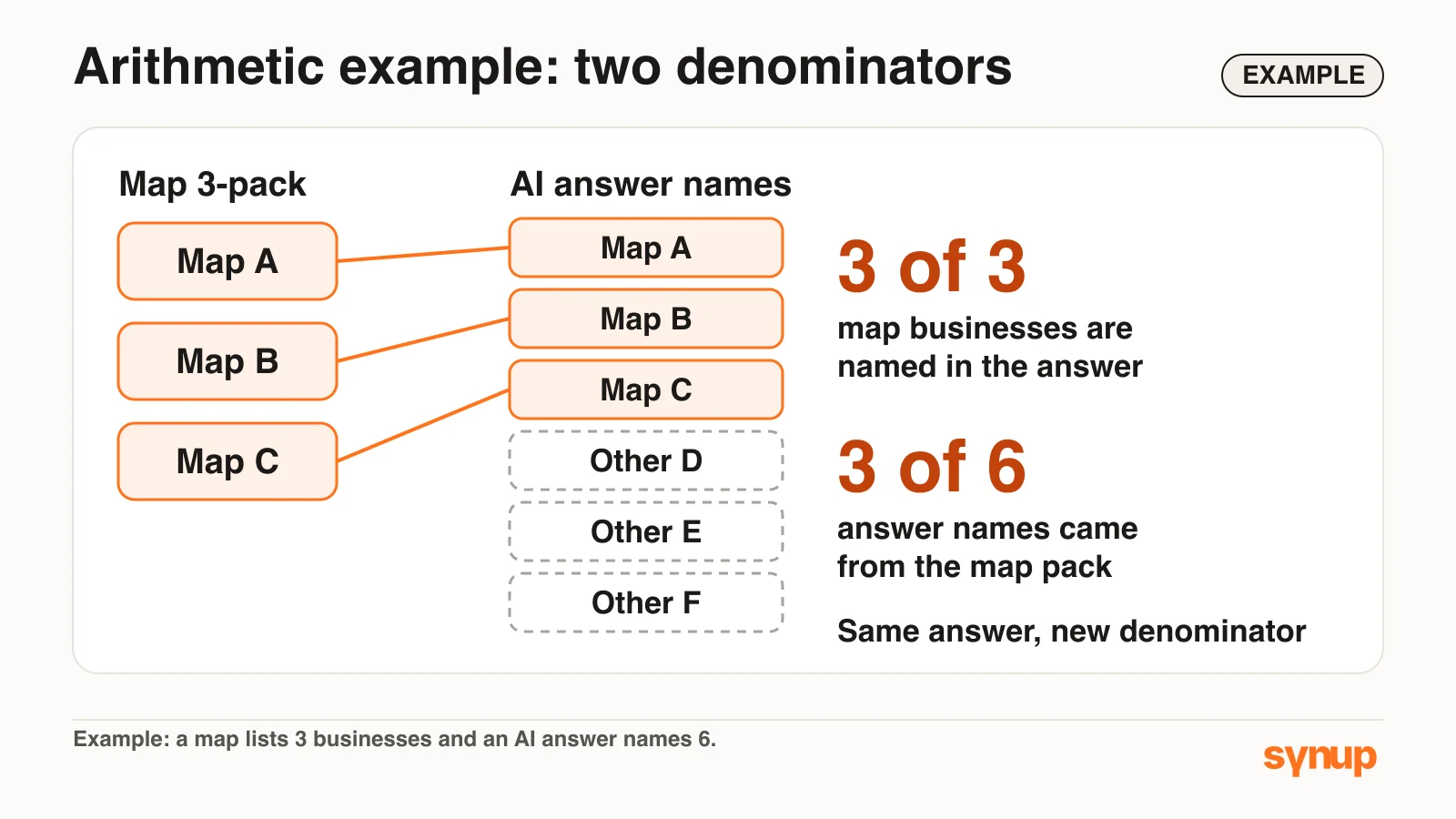
These findings do not conflict. The 64% starts from businesses on the map. The 67% starts from businesses in the answer. They use different denominators drawn from different samples. So 67% is not the complement of 64%, and it is not 67% of searches.
A hypothetical makes the distinction concrete. Suppose a map shows three businesses and an AI answer names six. All three map businesses appear in the answer, alongside three others. In that case, every map business made it into the answer (3 of 3), and half of the answer’s businesses came from outside the map (3 of 6). Both statements are true at once. The example illustrates the arithmetic only. It is not a measured page, and it does not describe how Google chooses businesses.
For reporting, the practical point is this: a map ranking is useful information, but it does not fully describe which businesses an AI answer names.
Named, source-only, or neither
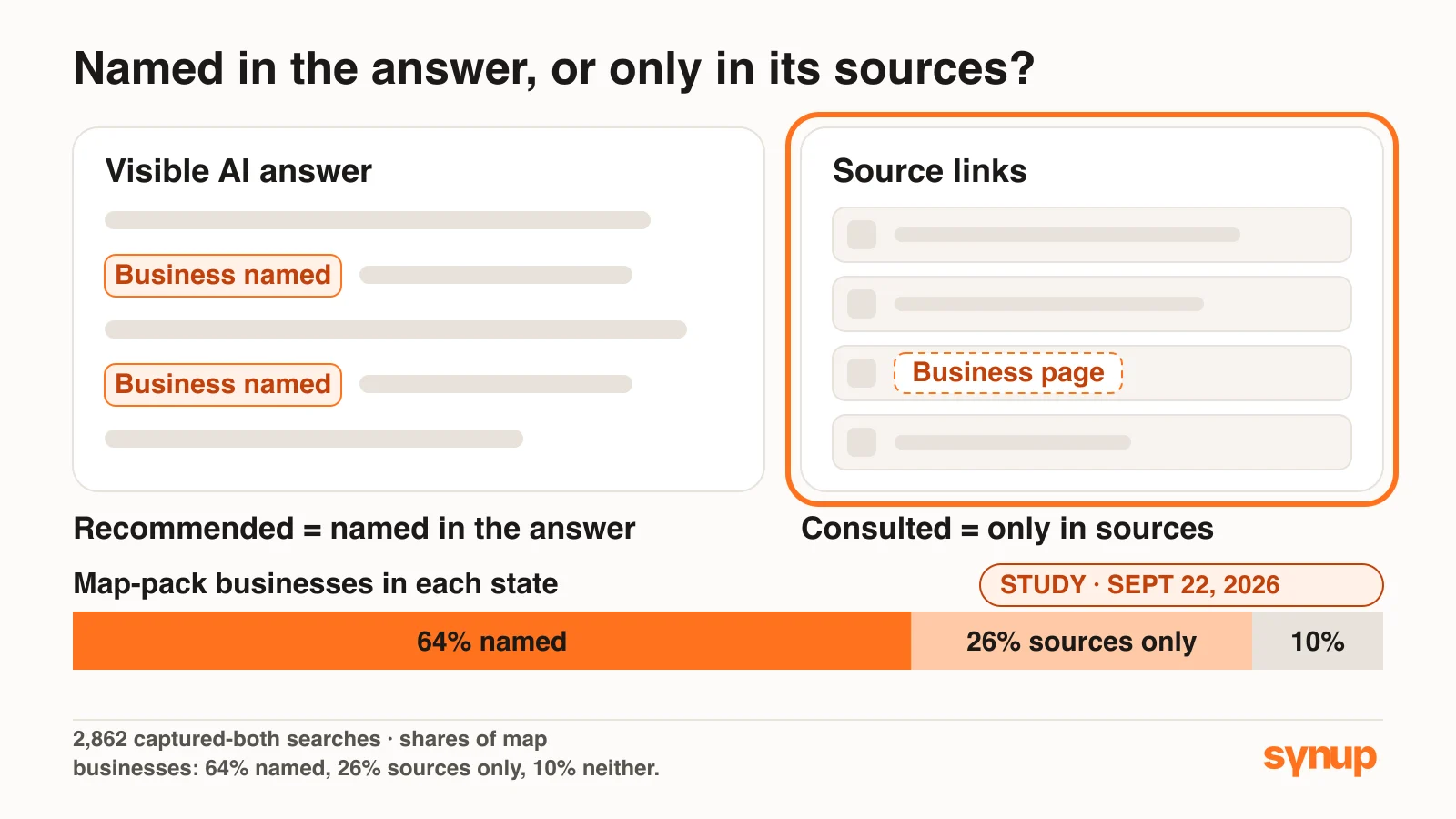
The AI answer contains a second distinction. A business can be named in the text a person reads. It can appear only in the panel of linked sources. Or it can appear in neither place.
The study labels the first state ‘recommended’ and the second ‘consulted’. These are operational labels for what was visible in the collected results. The source-panel label does not give us access to Google’s internal reasoning, attention or influence.
The same 64% is part of a three-state breakdown of map businesses on the 2,862 captured-both searches:
- 64% were named in the visible answer.
- 26% appeared only in the sources.
- 10% appeared in neither place.
A business owner reading a report should be able to tell two things apart. Would a customer meet the business in the answer itself, or would they need to open the sources to find it? Report these as separate results instead of combining them into one appearance count.
A practical report worksheet
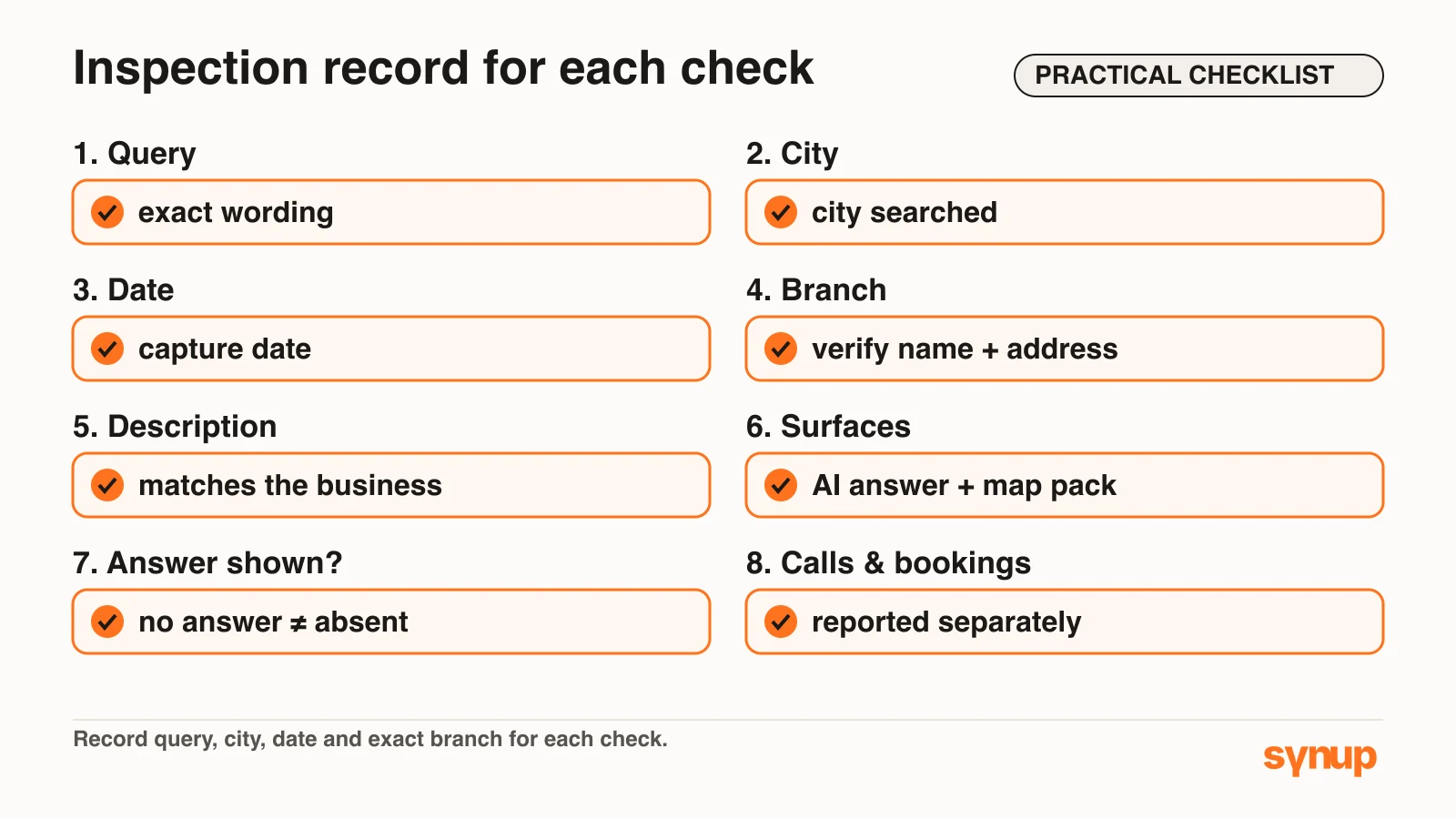
The study’s practical message is to ask a few separate questions and record each answer. A worksheet keeps those answers apart. Use one row per check:
| Field | What to record |
|---|---|
| Date | When the check was run |
| Exact query | The full search text, unchanged |
| Intended city | The city the business serves |
| Setup | Device and language or locale |
| AI answer capture | Captured / not captured / capture uncertain; verify live before calling an answer absent |
| In map pack? | Yes / no |
| Named in answer? | Yes / no / not applicable when no answer exists / unverified |
| Source panel state | Named in sources only / neither / not applicable / source panel not inspected |
| What the answer says | The description text, copied |
| Identity check | Name, address and services correct? Right branch and city? |
| Evidence | Screenshot or saved observation reference |
| Next step | Correction to review, or a re-check date |
Download the editable AI visibility worksheet, then fill it in:
- Keep the exact query, intended city and date with every example. Results can change with any of them.
- Verify the address. Some cities share a name, and the study found some results from the wrong city. Confirm you are looking at the right branch.
- Read the description, not just the mention. Check that the name, location and services are right. If something is wrong, review the business’s own information first and work out what can be corrected. Review corrections against the location’s approved information; the study does not show that these edits secure AI recommendations.
- Record a no-answer search as its own status. A tool returning no answer can mean no answer was shown, or that capture missed it. Verify the result live when practical. An absent answer does not mean the business failed to appear in an answer that existed.
- Repeat the check over time. One page is an example to investigate. Repeated checks show whether a pattern deserves attention. A handful of spot checks cannot estimate how often a business is missed.
Keep business outcomes in a separate section. Calls, inquiries and bookings describe what the business gained. Search appearances describe where customers could encounter it. Both are useful, but putting them in the same row invites a causal reading the data does not support.
A hypothetical filled row. Suppose a captured answer names Business X, the map has not yet been checked and the source panel has not been inspected. This illustrates recording states, not a real search result:
| Exact query | Intended city | Date | Capture | Map | Named in answer | Source panel | Next step |
|---|---|---|---|---|---|---|---|
| best [category] in [city] | [target city] | [capture date] | Captured | Unverified | Yes | Not inspected | Verify name, address and branch; save evidence |
A blank field would hide uncertainty. Use an explicit unverified or not-inspected state instead.
City size and category
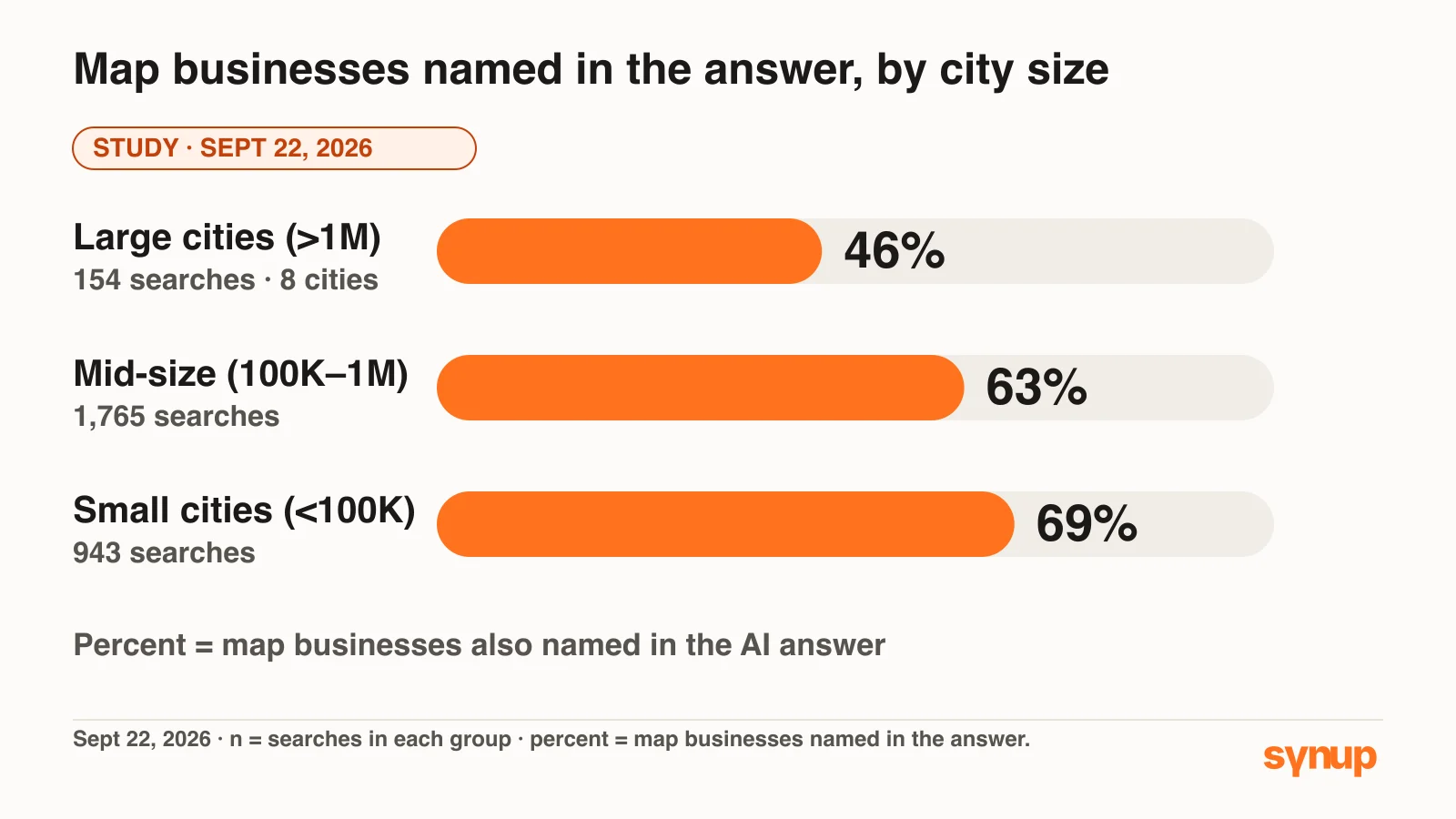
Overlap varied by city size. The share of map businesses named in the AI answer was:
| City group | Map businesses named in answer | Searches (n) |
|---|---|---|
| Large (over 1 million people; 8 cities) | 46% | 154 |
| Mid-size (100,000 to 1 million people) | 63% | 1,765 |
| Small (under 100,000 people) | 69% | 943 |
The large-city group is the smallest sample: 154 searches across eight cities. Do not treat its exact percentage as a figure that applies to every major city. All three groups are observational. They show what was captured. They do not show that city size causes the difference.
Categories varied as well. In the study’s appendix, AI answers named 41.4% of map businesses for hospitals (n=107) and 57.4% for lawyers (n=97). Here, n counts searches. These two examples have small samples. They are useful for setting expectations about variation, not as a formula for any category.
Citations changed between two September snapshots
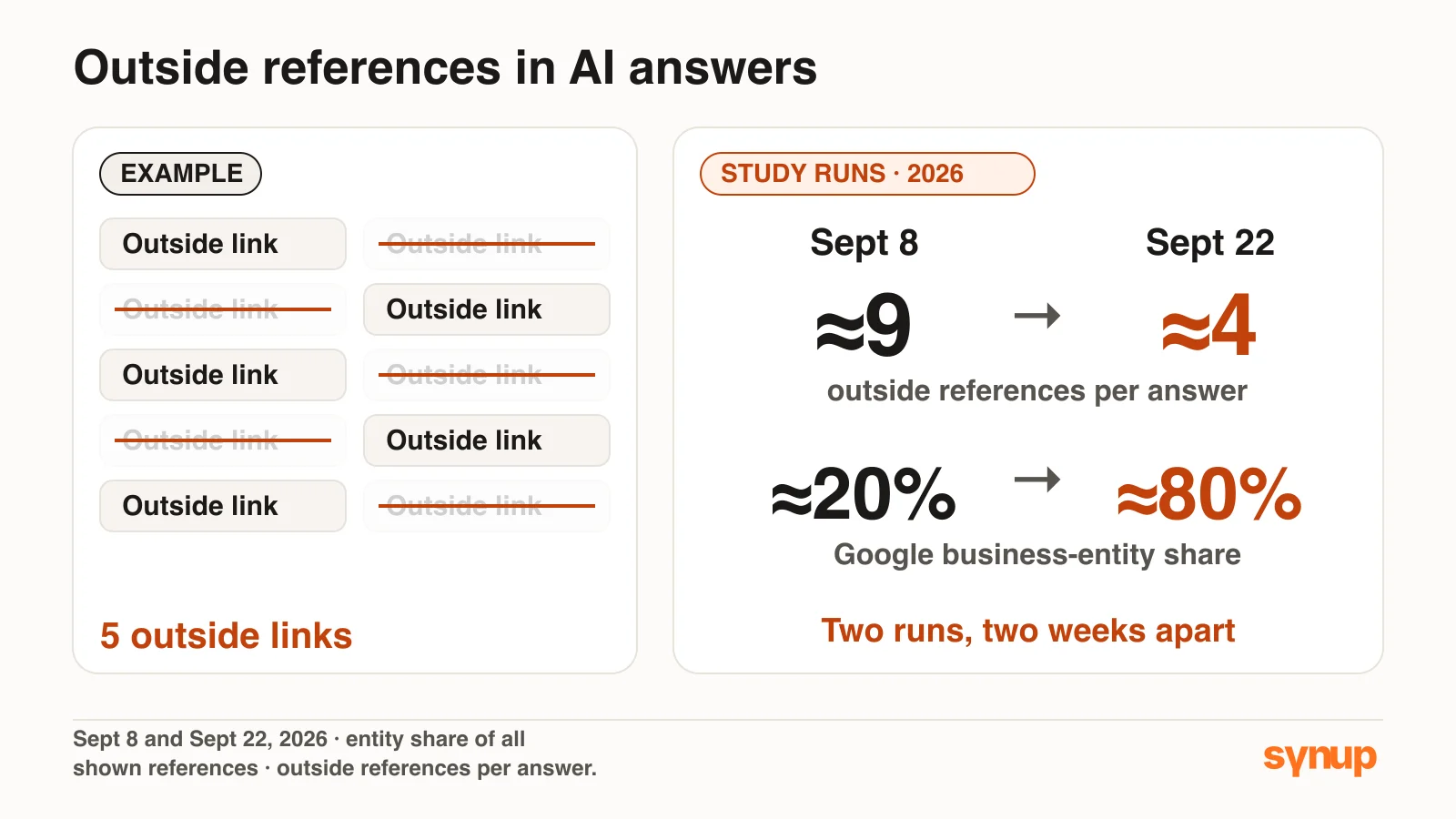
The study also compared the sources shown with AI answers across two runs, one on September 8, 2026 and one on September 22, 2026. The base for these figures is the references shown with captured answers in each run. The study reports rounded shares and averages and does not publish total reference counts for each run.
- The share of Google business-entity references rose from about 20% in the September 8 run to about 80% in the September 22 run.
- The average number of outside website references per answer fell from about 9 to about 4 between the same two runs.
These Google business-entity references point within Google’s own system rather than to an outside website. The shift describes the references displayed with the answer; it does not measure clicks or establish whether outside websites became less influential.
Among outside references, businesses’ own websites were the most common source type. They made up about 50% of outside references in the September 8 run and 46% in the September 22 run. Those are shares of outside references, not of all citations.
This matters when a report says a particular website was cited less often. Before concluding that the site became less useful, check whether Google showed fewer outside references overall. Two snapshots show a change between two dates. They cannot tell you whether the change was gradual, whether it continued, or whether it later reversed.
What Google says about AI features
Google’s documentation on AI features and your website (retrieved October 7, 2026) says there is no special markup or additional technical requirement for appearing in AI features. Supporting pages need to be indexed and eligible to show a snippet, and appearance is not guaranteed. This is external context, not a finding of the Synup study.
Before sharing the report
Check for the reading errors this study surfaces:
- treating a map ranking as a complete picture of AI answers
- comparing percentages that have different denominators
- reading a drop in citations as a drop in a site’s usefulness
- generalizing a September 2026 snapshot to today’s results
The full methodology, category comparison and data are in the original study.
Put your local marketing in motion.
Manage listings, reviews and local visibility in one place. Sydekick, your AI agent, lines up the work and you approve what goes live.
- 14-day free trial
- $50 in AI credits
- Cancel anytime