
Manual vs automated listing management: is doing it by hand worth it?
Listings are a local business's storefront: local consumers decide where to go within minutes of searching, often without visiting the website. Google Business Profile alone isn't enough, because search now spreads across Apple, Bing, ChatGPT, Perplexity and Gemini, and each pulls from different sources. Creating listings is only the start; relevance, reviews, popularity and freshness need work every week. By hand, that means time every day, data that drifts, reviews on every platform and manual errors. An automated platform gives one source of truth and handles much of the routine work.
Picture a bakery in New York City that sells macarons. Someone nearby wants macarons, so they search. Within minutes they’ve picked a place, and often they never open the bakery’s website at all. Everything they needed came from the listing: the address, the hours, the reviews. That search is where the manual vs automated listing management question starts.
Sudy Rao, VP of Sales at Synup, starts with that search because it explains why the question matters. For a local business, Sudy says, the listings are the storefront. The real question is whether to run them by hand or use an automated platform.
Short answer: Manual listing management can work for a while, but it stops keeping up. Google Business Profile alone isn’t enough, because search now spreads across Apple, Bing, ChatGPT, Perplexity and Gemini, and each pulls from different sources. Creating listings is only the start: relevance, reviews, popularity and freshness need attention every week. Done by hand, that costs time every day, lets data drift, scatters reviews across platforms and invites errors. An automated platform gives you one source of truth and does much of the routine work for you.
Watch: manual vs automated listing management
What listings are, and who needs them
Listings, also called citations, are your business data as it appears on publishers’ sites, maps and directories: your name, address, phone number, hours, categories and more.
They aren’t only for storefronts. Sudy points out that local service businesses depend on them just as much: plumbers, electricians, agencies and any service business that targets local consumers.
How local search works now: intent decides what people see
Local search is changing all the time, Sudy says, but one default holds: search engines read the intent behind the words.
- Local intent brings the map pack (also called the local pack). Search for “best bakery”, even without “near me”, and the results turn local. Search for “best CRM software” and you get no local results, just blue links. When the keywords carry local intent, the map pack beats the blue links.
- Aggregators win the blue links. Below the map pack, aggregators such as Yelp and Yellow Pages (YP.com) almost always outrank a local business’s own website, even on a local search.
- AI Overviews show up more on conversational searches. A plain “best bakery” still brings up the map pack with blue links below it. A longer, conversational question, such as “best bakery that sells the best macarons in New York City”, can trigger an AI Overview instead. A conversational question with a local need can still pull in local results.
So the same business can be found in a map pack, in a directory’s listing or in an AI answer, depending on how someone asks. Each of those draws on listing data.
Why Google Business Profile alone isn't enough
A complete Google Business Profile matters, but Sudy is clear that on its own it isn’t going to cut it. Search is fragmenting across Google, Apple, Bing, ChatGPT, Perplexity, Gemini and more, and each AI engine pulls its data from different sources:
- Gemini leans almost entirely on Google’s data.
- The others lean on Bing, Yelp, Facebook and many other sources.
Listings on trusted publishers also raise Google’s confidence in your business.
That doesn’t mean you need to be everywhere. Quality beats quantity. In Sudy’s view, the top 10 search sites and perhaps the top 100 publishers that get indexed on Google are worth far more than spreading your business information across a thousand directories that don’t make sense for you.
Listings aren't a one-time job: the ranking factors
Creating listings gets you present when the searches happen, Sudy says, but that’s only the starting point. What matters is how well you optimize those listings for the ranking factors:
- Relevance: your categories, subcategories or additional categories, your products and services, and your descriptions.
- Proximity: the default filter Google applies the moment someone runs a “near me” search. It usually pulls up the nearest location, but proximity doesn’t always win.
- Reputation and reviews.
- Popularity: photos, user-generated content and the busy times Google tracks automatically.
- Freshness of your content.
Single words in a search change the results too:
| The search includes | What happens (as Sudy describes it) |
|---|---|
| “best”, as in “best macarons” | Google filters the results, even on Maps, to businesses rated 4 stars and up |
| “now”, as in “best bakery to buy macarons now” | Only businesses open at that moment are shown |
| “near me” | Proximity becomes the default filter, though the nearest location doesn’t always win |
Keeping every one of those boxes checked every day, week and month is what keeps a business relevant and ahead in local search. That’s why Sudy calls it a continuous optimization task, not a one-time job.
The hidden cost of manual listing management
Here is where doing it by hand starts to hurt. Sudy walks through what a business owner actually takes on:
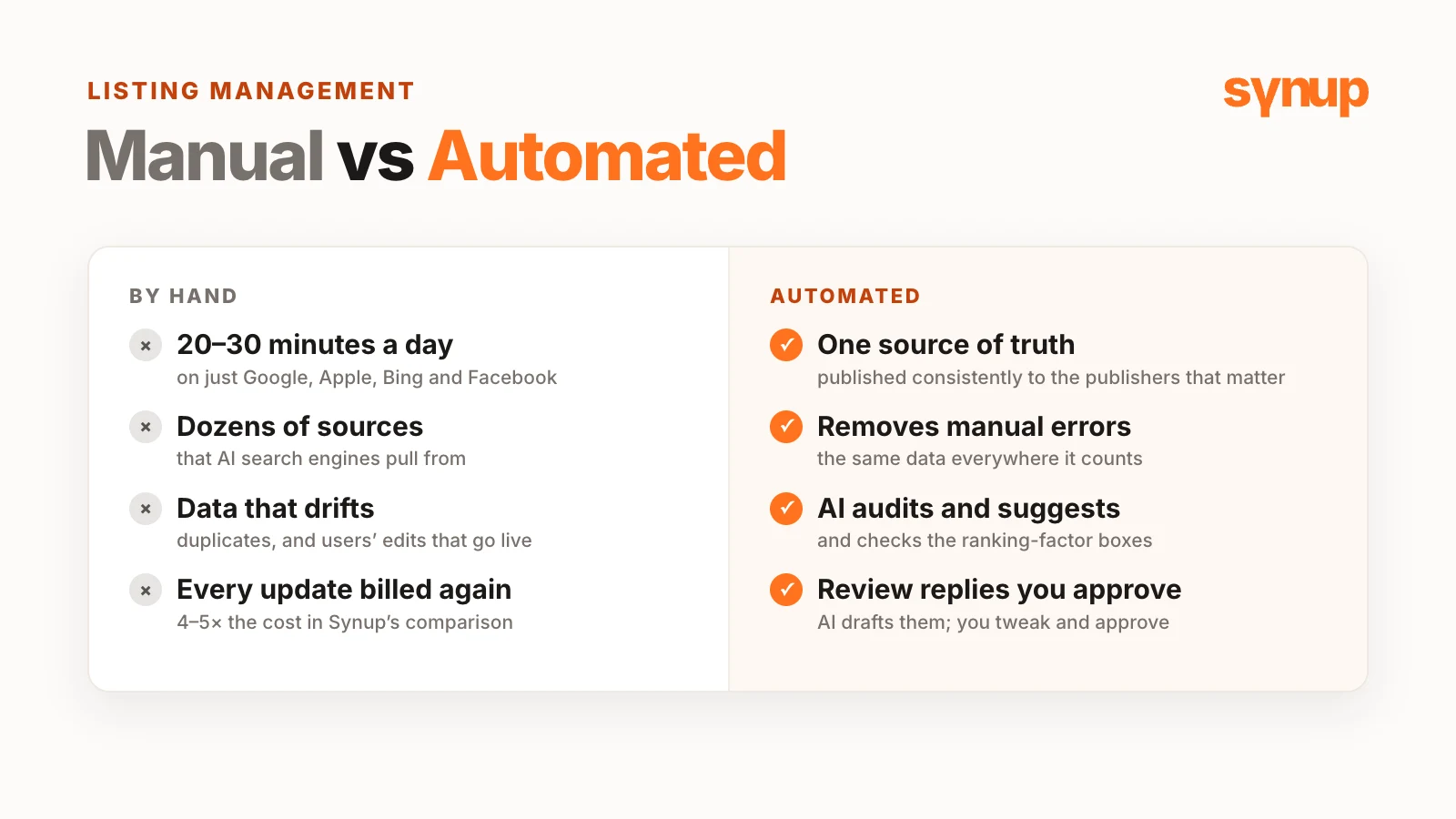
- Time, every day. A typical owner may spend 20 to 30 minutes a day on just Google, Apple, Bing and Facebook. That alone isn’t easy.
- Dozens of sources. AI search engines such as Gemini, ChatGPT and Perplexity pull from dozens of sources. Managing all of them by hand takes far more than 30 minutes.
- Data that drifts on its own. Third-party sites sometimes create duplicates. Suggested edits from consumers on Google can go live without the owner approving or rejecting them; Sudy estimates that happens within 48 to 72 hours if you don’t respond. (For how stale data finds its way back into a listing, see why business listing updates keep reverting.)
- Reviews on every platform. Each platform has its own reviews to monitor, understand and respond to.
- Manual errors. The more places you update by hand, the more chances to get something wrong, compared with a platform that keeps your data consistent.
All of that becomes a hidden cost: time spent managing and optimizing listings instead of running the business. (To put your own numbers on it, see how to calculate the ROI of local listing management software.)
Hiring a service provider to do it manually adds another hidden cost. Manual providers usually charge to create the listings first, then charge again for every update you ask for. Synup did that math against some manual service providers, Sudy says, and doing it that way ends up costing four to five times more than an automated platform.
Manual vs automated listing management, side by side
| By hand | With an automated platform | |
|---|---|---|
| Daily time | 20–30 minutes on just Google, Apple, Bing and Facebook; more with dozens of AI sources | One source of truth, published to the publishers that matter |
| Data accuracy | Duplicates and users’ edits can change listings without you | Consistent data that removes manual errors |
| Ranking factors | Relevance, reviews, popularity and freshness checked by hand | The ranking-factor boxes checked as part of the routine |
| Reviews | Each platform checked and answered separately | Unanswered reviews pulled up and replies drafted for approval |
| Cost | Providers bill to create listings, then for every update (4–5× an automated platform in Synup’s comparison) | A platform instead of per-update fees |
What an automated listing management platform changes
Automation, Sudy says, gives you one source of truth and distributes your business data consistently across multiple publishers. That removes manual errors and keeps you up to date across the publishers that actually help you, and it makes it easier to check the ranking-factor boxes.
AI makes it easier still. Listing management platforms can now audit your listings automatically, suggest improvements and do much of the work for you. Sudy’s example is a single command: pull up all the reviews from the last week that you didn’t respond to, and have the AI generate a personalized reply for each one. You step in, look at the drafts, tweak anything you need and approve them. Synup’s listings software works this way.
Freshness gets simpler too: posting, or updating descriptions and offers across all your listings, happens from the listing manager instead of one site at a time.
Who should switch from manual to automated
Sudy closes with a plain verdict. For a small business owner, or a business with multiple locations, managing business data, freshness, reviews and every other ranking factor by hand is “one heck of a job” that eats time every single day and week, for whoever owns it. An automated platform keeps everything consistent. For a broader guide to the work itself, see the local listing management guide.
Common questions about manual vs automated listing management
What is the difference between manual and automated listing management?
Manual listing management means someone logs in to each platform, such as Google, Apple, Bing and Facebook, and updates the business data, checks for changes and answers reviews one site at a time. An automated platform keeps one source of truth for the business data, publishes it consistently across the publishers that matter, and helps with audits, review replies and updates from one place.
Is a Google Business Profile enough for local search?
Sudy's answer is no. Search is spreading across Google, Apple, Bing, ChatGPT, Perplexity and Gemini, and each AI engine pulls data from different sources: Gemini leans on Google's data, while others lean on Bing, Yelp, Facebook and more. Listings on trusted publishers also raise Google's confidence in a business.
How much time does manual listing management take?
Sudy estimates that a typical business owner spends 20 to 30 minutes a day on just Google, Apple, Bing and Facebook. Once you add the dozens of sources AI search engines pull from, it takes more than that, before you count reviews, suggested edits and duplicates.
Can other people change my business listing on Google?
Yes. Users can suggest edits to a Google listing, and those edits can go live without the owner approving them. Sudy estimates the window at 48 to 72 hours if the owner doesn't respond, which is why someone needs to watch for suggestions on every listing.
What does an automated listing management platform do with AI?
Sudy describes listing platforms that audit listings and suggest fixes automatically. In Synup you can ask for last week's reviews you haven't answered, have the AI draft a personalized reply to each one, then tweak and approve the replies yourself.
Next step
List every place your business appears today, and note who updates each one and how often. If the answer is “one person, by hand, when they remember”, that’s the gap Sudy describes. To see how one source of truth works across your listings, reviews and updates, see Synup’s listing management software.
Put your local marketing in motion.
Manage listings, reviews and local visibility in one place. Sydekick, your AI agent, lines up the work and you approve what goes live.
- 14-day free trial
- $50 in AI credits
- Cancel anytime